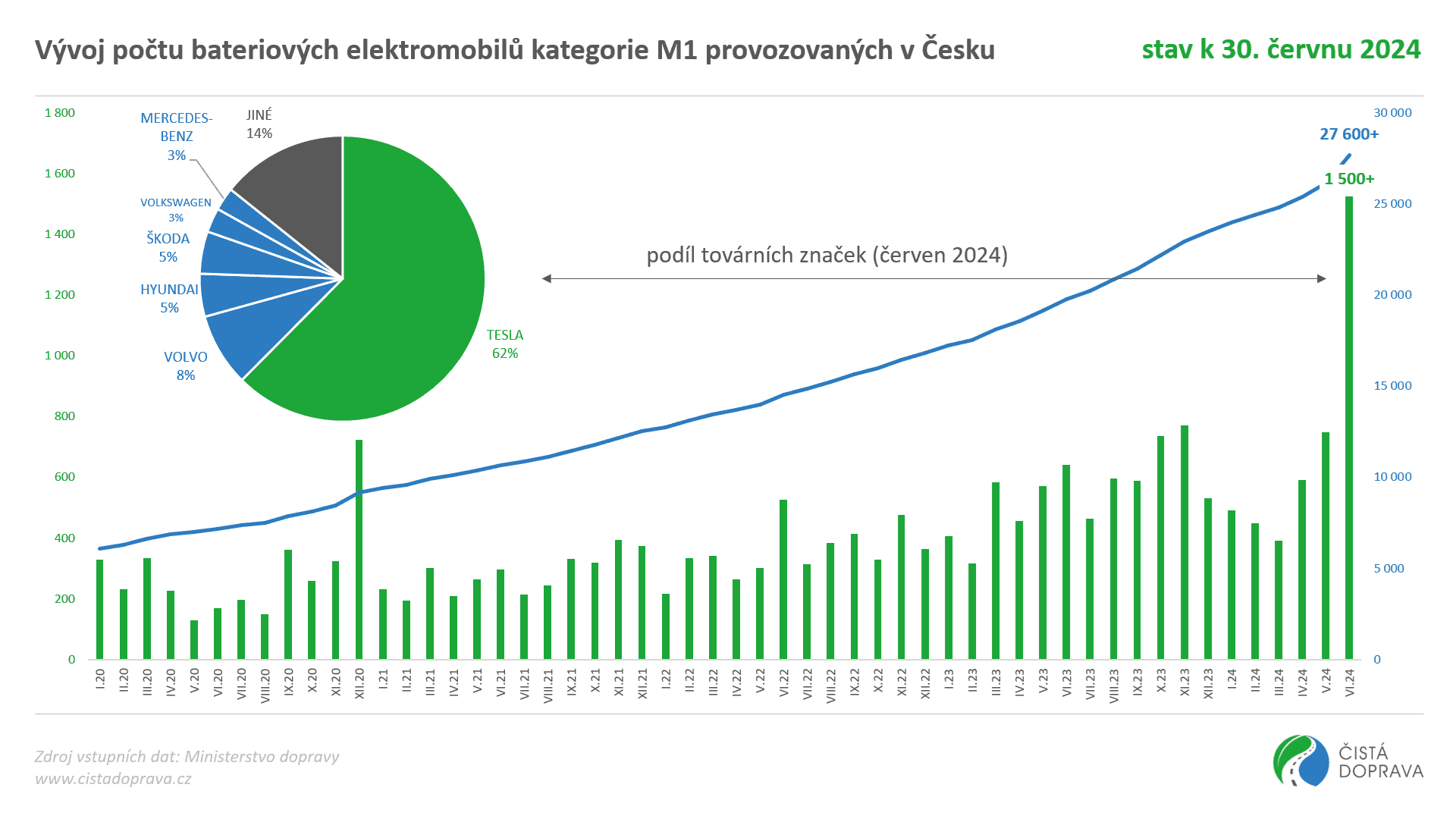
In June 2024, Czechia saw a remarkable surge in the registration of new battery electric vehicles (BEVs), with over 1,500 new passenger BEVs hitting the roads. This unprecedented growth pushed the market share of BEVs to nearly 7%, both record highs for the country.
Currently, more than 27,600 battery electric passenger vehicles are in operation on Czech roads. The first half of 2024 alone saw an increase of over 5,000 BEVs, supported by more than 5,200 public charging points across the nation. This data is sourced from the latest updates on the Čistá Doprava website, based on information from the Ministry of Transport.
For only the second time in history, Czechia registered over 1,000 new BEVs in a single month. The previous peak was in December 2020, heavily influenced by the launch of the Škoda Enyaq. However, June 2024 surpassed this with more than 1,500 registrations, significantly driven by Tesla, which captured a 62% market share. Following Tesla were Volvo, Hyundai, and Škoda, each with around 5-8% market share.
Lukáš Kadula from the Transport Research Centre highlighted the factors contributing to this surge, including delayed demand from Q1 and the gradual roll-out of the National Development Bank's ELEKTROMOBILITA Warranty Program, which started in March. Tesla's traditional strong end-of-quarter performance saw over 900 new vehicles registered in June, with the Tesla Model 3 and Model Y being the most popular.
In terms of regional distribution, Prague led with 31% of the new BEV registrations, followed by the South Moravian Region (15%), the Central Bohemian Region (12%), and the Moravian-Silesian Region (10%).
According to the National Development Bank (as of June 25, 2024), the ELEKTROMOBILITA Warranty Program had seen 1,954 contracts signed, with 132 applications approved and 446 in progress. Detailed information about the program is available on the National Development Bank's website.
Of the 5,201 public charging points in operation, 3,778 are standard AC (72.6%), 1,111 are high-power DC (21.4% up to 149 kW), and 312 are ultra-fast DC (6.0%). Despite the current state of charging infrastructure being robust, there is still room for improvement, particularly in the expansion of high-power charging stations. The Operational Program Transport 2021-2027 (OPD3) focuses heavily on this development, aiming to further enhance the network over the next three years.
For ongoing updates and detailed information, visit the Čistá Doprava website, which operates with the financial support of the Ministry of Transport under the long-term conceptual development program for research organizations.
For more detailled data in Czechia check out the website: https://www.cistadoprava.cz/registrace-vsech-cistych-vozidel-v-cr-dle-nap-cm/
Source Data:
- Ministry of Transport Statistical Reports
- National Development Bank
- Čistá Doprava website (Link)